
Sep 20, 2011
Term 4 Novel Study

Aug 29, 2011
Monday - Period 2
Now we have completed our abridged reading we will start our study of Macbeth with the following:

- An overview of Shakespeare's 5 Act Structure as it pertains to this play;
- Quick revision of the forms of conflict (see diagram below)
- Character profiles for Macbeth and Lady Macbeth: on your Weebly create a new page for 'Macbeth' and a sub-page for 'Characters'. On the 'Character's page compose paragraphs for both of these characters in which you describe their personality, actions, thoughts and reputations. Accompany your paragraph with an image found on the internet that you best think represents them. Also locate and include under your paragraph 2 quotes from the text that are important in representing aspects of the character you are describing.

Aug 25, 2011
Week 6
As we finish our reading of the script, you might be interested in looking at some of these apps and websites. They will assist your study of 'Macbeth' either with the translation of Shakespeare's original text, or to understand the narrative elements and characterisation of the play. Note that you are NOT required to purchase any apps unless you feel they assist you.
Macbeth Digital Resources
Weeks 3-6
We will begin our Shakespeare unit by looking at his background, writing style and conventions, his playhouse, 'The Globe Theatre', and his extensive list of plays and their categories. A quick game of Shakespeare bingo will reveal how prolific a writer he was.
Some short focus videos will give us an overview of his play, 'Macbeth' and we will begin our reading of an abridged script accompanied by video, some extracts of which appear below.
Some short focus videos will give us an overview of his play, 'Macbeth' and we will begin our reading of an abridged script accompanied by video, some extracts of which appear below.
Aug 8, 2011
Monday - Period 5

How does the film, The City of Ember, rely on the dystopian genre and the hero's journey in telling its tale. Support your answer with specific text references.
Picture This Homework due Monday Week 5 - 'Water Fever' by Jenny Mounfield (p221)
Wednesday - Period 1
Shakespeare Incursion - today you will view performers who put Macbeth and Lady Macbeth on trial to decided who is the most guilty of killing King Duncan. This is in anticipation of our drama unit which will start on Wednesday, 10/08/11. For a very brief and amusing introduction to Macbeth take a look at this 'Macbeth in 96 seconds' video.
Aug 1, 2011
Monday - Period 2 & Tuesday - Period 4
Short story final copy to be submitted in this lesson.


Jul 31, 2011
Week 2 Lessons
This week our lessons included:
Monday - in this lesson we looked at the characteristics of dystopian fiction and then made links to where these characteristics exist in the film, 'The City of Ember'. We also looked at elements of dystopias generally (see mind map below).


Monday - in this lesson we looked at the characteristics of dystopian fiction and then made links to where these characteristics exist in the film, 'The City of Ember'. We also looked at elements of dystopias generally (see mind map below).

Wednesday - today we concentrated on the back story contained in the film by examining the extracts that showed the builders establishing Ember in order to protect mankind from destruction. You should have made notes from the deconstruction that identified how the filmmaker achieved the back story.

Thursday - today we returned to the writing process for our short stories. You peer-marked another students work to provide them with feedback on all elements of their draft. At the conclusion of the peer marking you received your draft, the comments from the peer marker, and comments from Mrs Lans. Using the feedback on your draft you are not to revise and edit your text to produce your completed version. This is due for submission in class on Monday, 1st August.
Jul 13, 2011
Wednesday - Period 1

CINDERELLA INC: Given the loss of a number of lessons recently (Long Weekend, Polding Walk, Staff Development Day) we will look at Christopher Anvil's short story, 'Cinderella Inc' through a reading and discussion. This story speculates on how we as a society view surgical attempts to create physical beauty. By the end of this story you should have recognised a number of familiar elements that occur in contemporary society and how Anvil has projected they may develop in the future. We will also look for the conventions of the science fiction genre as used by Anvil.
To finish the term you will compose a paragraph that explains how the word 'corruption' is relevant to your wider reading of Jeanne du Prau's 'The City of Ember'. We will spend the final two lessons viewing the film adaptation in anticipation of our film study starting Term 3.
Jun 7, 2011
Tuesday - Period 4

In particular, you will compose questions using the 'Questioning Circles' model to explore both the text and how this idea relates to the wider world.
Thursday - Period 1 & Monday Period 2
In these lessons you will participate in a small discussion group with Mrs Lans OR take part in a backchannelling discussion around Ray Bradbury's short story, The Pedestrian.
Transcripts of the backchannel sessions appear below:
Transcripts of the backchannel sessions appear below:
Genre - Short Stories & Film

Tasks:
- Using Mindomo, Mindmeister, or Mind42, compose a mind map of the main genres and their features. Embed this mind map on your Weebly.
- Select a movie trailer, embed it on your Weebly, and then list the genres it contains and the conventions used in the trailer that confirm those genres.
May 19, 2011
Thursday - Period 2
Today you will record a reading of your 'found poem'. Remember that you need to consider the tone and pace of your reading so that it reflects the subject matter and content of your poem.


- Use Audioboo to record your poem.
- Copy the embed code for the recording before leaving Audioboo.
- Create a sub-page on your Weebly using the title of your poem as the title of the page.
- Slide a 'HTML code' button down to the page and then past into the box to insert your recording on the page.
- Underneath the recording, type or copy the text of your poem.
- Finally, add an image or two that is representative of ideas in your poem.
May 18, 2011
Weeks 1-3 Term 2

27/04/11: 'Dulce Et Decorum Est' deconstruction continued
02/05/11: 'Dulce Et Decorum Est' response task
04/05/11: NAPLAN practise writing task
05/05/11: 'Dulce Ed Decorum Est' response task continued
09/05/11: NAPLAN revision and review
10/05/11: NAPLAN Testing
11/05/11: NAPLAN Testing
16/05/11: Poetry Composition - Found Poem
18/05/11: 'War is Kind' - annotation, deconstruction and paragraph response
Apr 6, 2011
Wednesday - Period 4 & Thursday Period 1/Week 1 & 2 of Term 2
Today we will look at a famous poem by a famous war poet, Dulce Et Decorum Est by Wilfred Owen. We will look at a few videos to provide us with Owen's personal and historical backgrounds. The poem itself is effectively dramatised in the video below.
Post reading activities:
- Discussion of the poem's ideas and effectiveness
- Annotation and deconstruction of the poetic devices employed (refer to glossary and mind map for support)
- Completion of a deconstruction sheet
- Completion of a range of tasks to be completed both in your books and on your Weebly.
Monday - Period 5
'What Matters?' drafts due today.
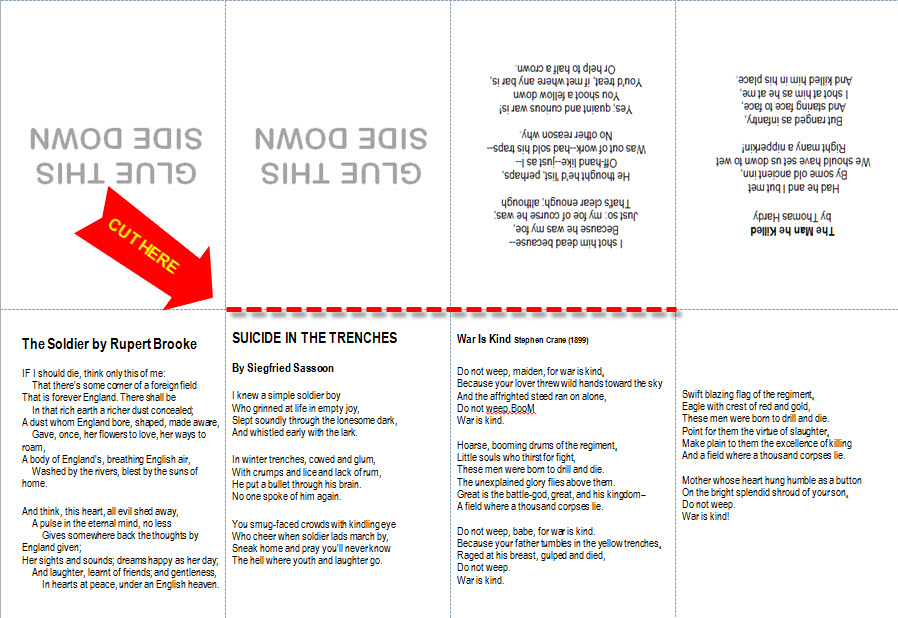
 To commence our study of war poetry you will construct a 'mini poetry book' and read silently to yourself. Reflect on the ideas and messages of each poem and then decide which poem resonates with you. Be prepared to discuss and justify your decision. Annotation of one poem if time.
Mar 24, 2011
Thursday - Period 2

Today we will begin our poetry unit that will focus on 'Images of War'. We will revise poetic techniques and elements through a glossary and mind map that is to be glued in your book.
Following some focus activities and discussion you are asked to post a response to the Wallwisher wall below. In our next lesson you will embed this completed wall on a new Weebly page.
Mar 15, 2011
Week 8 Lessons
 As an extension of our study of documentaries, you will this week create your own documentary that presents the College in a favourable or negative light. You should have completed the planning sheet on Monday that outlines your approach, will spend 1-2 lessons shooting video footage and taking still photographs, and the last lesson compiling your work in MovieMaker.
Completed documentaries need to be submitted on the school network. You will compose a reflection statement on your Weebly that considers the learning experiences that this task has given you.
Your books need to be handed up in Wednesday's lesson for checking.
Mar 14, 2011
Monday - Period 2

- Completion of your written analysis of 'Men of Ore' on your Weebly. This must be finished and published today.
- Self-Assessment of your achievement of this task (see Mrs Lans for a sticker for your book).
- Ensure the 'Contents Page' and all work that should be in your book is up to date.
- Documentary Planning Sheet to be completed for your one minute documentary presenting the College from a positive or negative perspective.
Mar 2, 2011
Wednesday - Week 5 to Thursday - Week 6

- the time mark of your chosen extract (eg. 16:34 - 17:39)
- the content addressed during this extract
- the film techniques employed -consider camera shots and angles, sound effects (diegetic and non-diegetic), lighting, soundtrack, archival footage/images, captions, editing (speed, aural bridge, transitions)
- the effects achieved by the filmmaker in using these techniques, ie. what is the effect on the documentary audience (responder)
Refer to your 'Documentary Film Response Scaffold' to guide your deconstruction. You can also discuss your thoughts with other students to clarify your ideas. When you are ready, use the scaffold to guide your response that you will post on your Weebly. Create a sub-page under the 'Non-fiction' tab called 'Men of Ore' and type your work there.
Subscribe to:
Comments (Atom)
